Everything You Need to Know About Collagen: Sources and Benefits

Properties of Collagen: How Does This Natural Protein Work in Our Body?
In the cosmetics market, collagen represents an exceptionally interesting and widely used ingredient, applied in various forms: as a filler, as a component of topical cosmetic products (creams, gels, serums, masks), and as a dietary supplement in the form of collagen hydrolysate for oral use. Collagen was first discovered back in 1865, and since then this important structural protein of the human body has been the subject of numerous scientific studies, while in the cosmetics industry it holds a significant place as an active ingredient in many products. It is a structural protein composed of amino acids that form collagen fibres, characterised by exceptional strength and high elasticity. Given its complex structure, collagens are among the most complex natural polymers, with more than 20 different amino acids potentially involved in their construction. The most abundant among them are proline, hydroxyproline, glycine, and hydroxylysine. All types of collagen have a characteristic triple helix structure, whether the entire molecule is organised in this form or only part of the collagen structure takes the helical shape. The structure of collagen itself varies depending on its function and site of origin within the body. In numerous biological structures, collagen serves as a type of binding agent, essentially acting as intercellular cement that holds tissues together. It provides strength, shape, resistance, mechanical support, and stability to all tissues in the body. It connects bones into joints, forms sheaths around organs and separates them from one another, links the skin to subcutaneous structures, envelops muscles and muscle groups, and lines and protects blood vessels and nerves. Collagen is also a key building element of the skin, without which it could not properly perform its functions. Collagen proteins in the dermis are continuously renewed, and their fibres are distinguished by exceptional resistance to stretching and tearing. In a healthy, young body, collagen is continuously renewed at a rate of approximately 3 kg per year. However, over time the capacity for collagen fibre regeneration diminishes. Collagen levels in the body begin to decline after the age of 25, with a more pronounced decrease observed after the age of 50. Reduced collagen concentration can also be seen in younger individuals as a result of genetic and hormonal factors. This process is further exacerbated by stress and other external influences, while collagen biosynthesis is additionally impaired during menopause. Collagen fibres in the skin's dermis are particularly susceptible to damage caused by UV radiation, sugar molecules (as a consequence of the glycation process), and free radicals generated by illness, smoking, and stress. Although the skin has natural mechanisms that regulate collagen synthesis, these become less efficient over time. The most noticeable sign of functional collagen loss in the skin is a decrease in its firmness and an overall deterioration of skin condition. Collagen deficiency can also affect the hair, which becomes brittle and prone to increased shedding. Collagen owes its widespread use in the cosmetics industry to its high biocompatibility with the skin, as it is a natural component thereof.
Sources of Collagen: Advantages and Disadvantages of Different Collagen Sources
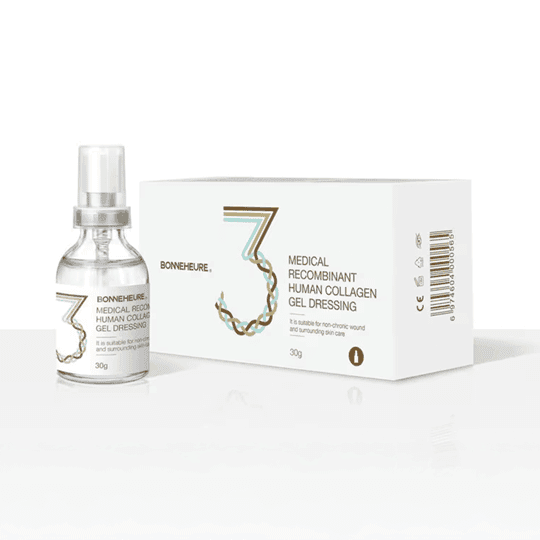
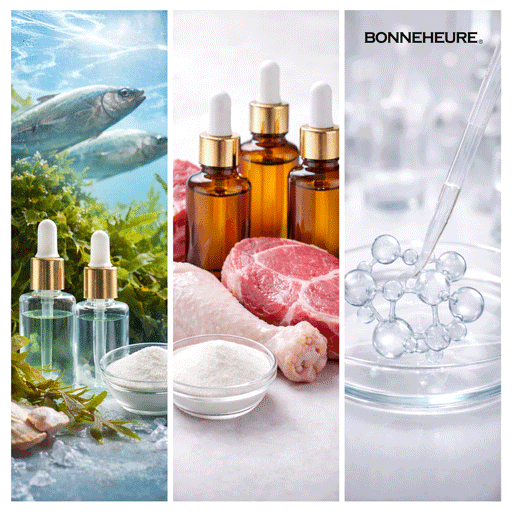
Sources of collagen for cosmetic products can vary, from traditional animal sources to modern biotechnological production methods. What sets Bonneheure products apart is the type and method of obtaining the collagen used in them, which offers numerous advantages over other sources. Traditional collagen sources include land animals such as cattle and pigs, as well as various marine organisms. Collagen extracted from industrial waste of cattle and pig processing is considered unacceptable for several reasons. Beyond ethical and religious considerations, there is also a risk of disease transmission, particularly bovine spongiform encephalopathy and foot-and-mouth disease. Today, numerous marine and freshwater organisms are also used as collagen sources; however, the use of collagen from these sources carries the risk of allergic reactions in sensitive individuals, as well as the possible presence of biological contaminants, toxins, and heavy metals in the final product. Bonneheure products contain recombinant human type III collagen, which, due to its properties, represents the optimal choice of collagen for cosmetic application. Its use eliminates the risk of pathogen contamination that exists with collagen of animal or marine origin. Cytotoxicity is also avoided, as recombinant collagen does not require aggressive chemical pre-treatment with acids or alkalis that may remain in the final product. Animal-derived collagen loses its natural triple helix structure during processing, thereby reducing its biological activity. In contrast, recombinant human collagen retains its biological activity under natural conditions, as well as its molecular weight and chemical and physical properties, even during the processing stage. Recombinant human type III collagen is characterised by greater hydrophilicity and better water solubility, while its biodegradability and higher tensile strength enable more effective skin penetration. The use of the Bonneheure product collection also eliminates batch-to-batch variability, which is common with animal-derived collagen, since the quality of the starting raw material from such sources cannot always be consistent. Thanks to its high degree of compatibility with human collagen, the recombinant human type III collagen contained in Bonneheure cosmetics delivers a pronounced positive, rejuvenating, protective, and hydrating effect on the skin.